

Defending Our Right to Community Living
Stay informed on federal policy shifts regarding the Olmstead decision, Medicaid, and SNAP benefits, and see how RGA actively protects disability services in Illinois.
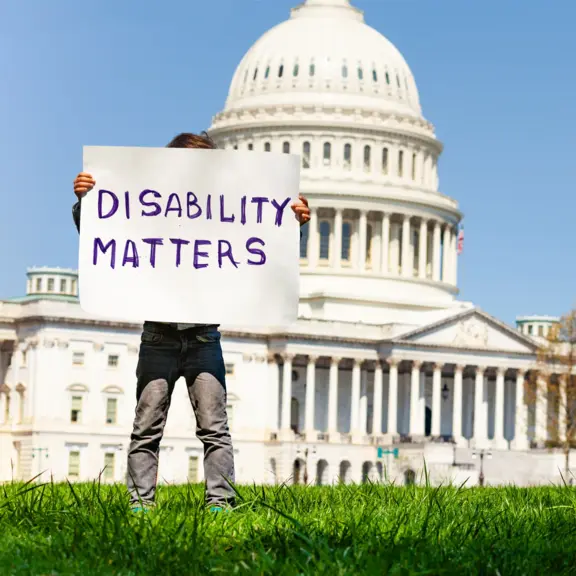
Right now, more than one in four adults in America live with some type of disability. It's a unique community: the only minority group that anyone can become a part of at any moment, whether through an unexpected accident, an illness, or simply the natural process of growing older.
That's why when we talk about defending the rights of people with disabilities, we aren't talking about a separate group of people. We are talking about our neighbors, our families, and our future selves. Protecting the freedom to live, learn, work, and play right here in our own neighborhoods isn't just advocacy for someone else. It's securing the baseline of dignity and belonging that belongs to all of us.
When federal and state policy decisions shift, they directly impact the daily health and basic well-being of the people we love. Today, the foundational promise of community independence faces major structural pressures from new federal legal interpretations and budget adjustments.
As a family, caregiver, or supporter, you deserve clear, honest facts about what these changes mean and how we are working together to steward the stability of the nearly 2,000 children and adults we support across DuPage County and surrounding areas.
Understanding the Federal Policy Shifts
Two major national policy conversations are currently creating ripple effects for disability services across the United States and right here in Illinois.
The Olmstead Decision Under Review
In 1999, the U.S. Supreme Court made a landmark ruling in Olmstead v. L.C., affirming that people with disabilities have a legal right to receive services in the most integrated, community-based setting possible.
Recently, the U.S. Department of Justice's Office of Legal Counsel issued an internal legal opinion suggesting that federal courts and past enforcements have interpreted this "integration mandate" too broadly. While this executive directive does not overturn the Supreme Court's original ruling, major advocacy organizations like The Arc of the United States warn that a pullback on federal enforcement could allow states to reduce funding for community programs in favor of larger institutional settings.
The Pressure on HCBS Funding
Home and Community-Based Services (HCBS) are the federal waiver programs that fund the daily supports allowing people to live, learn, work, and play in their own neighborhoods.
Unlike institutional care, which federal law mandates states must provide, HCBS community programs are technically classified as "optional" benefits under Medicaid. When federal budget adjustments squeeze allocations down to the state level, these optional community programs are often the first to face funding freezes or long waitlists. Because Illinois historically experiences tight funding structures for community services, these federal pressures require our constant vigilance and advocacy.
Proven Stewardship: How RGA Bridges the Gap
Policy instability is not new, and RGA has a proven track record of standing as a buffer between federal gridlock and the people who count on us. We believe that government funding provides a baseline of care, but our community's flexible partnership is what ensures true empowerment.
- The Medicaid Advocacy Strategy: When state and federal funding structures face uncertainty, RGA activates our families to share their stories. In March 2025, our friend Jonathan, a participant at Gateway Special Recreation Association, showed the power of self-advocacy. His letter about protecting Medicaid reached his U.S. representative, senator, and governor. We're committed to ensuring Illinoisans with I/DD have continued access to the vital services Medicaid makes possible, and their elected representatives.
- Stepping in During Government Shutdowns: When past federal budget standoffs led to partial government shutdowns, vital safety nets like Supplemental Nutrition Assistance Program (SNAP) benefits were abruptly suspended or delayed for millions of Americans. For individuals with disabilities living on fixed incomes, this sudden halt threatened basic food security. RGA rallied our community partners to fully fund the gap until benefits were restored, so no individual we support faced a disruption in their care.
We look at every legislative shift through a person-centered lens. We do not engage in partisan politics, and we do not use fear tactics. Our goal is simply to ensure that policy shifts never compromise the dignity of people with disabilities.