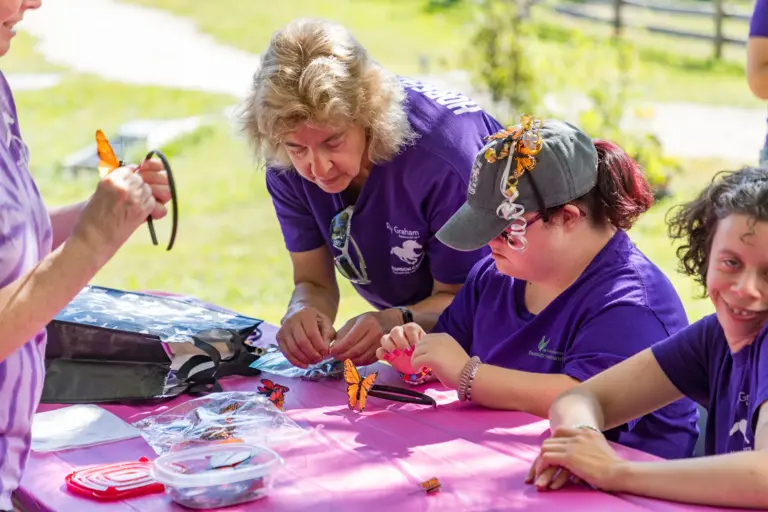

Investing in Empowerment: The Next 75 Years
See how we make a difference in the lives of people with disabilities and their communities. Read our most recent annual report and financing plan.
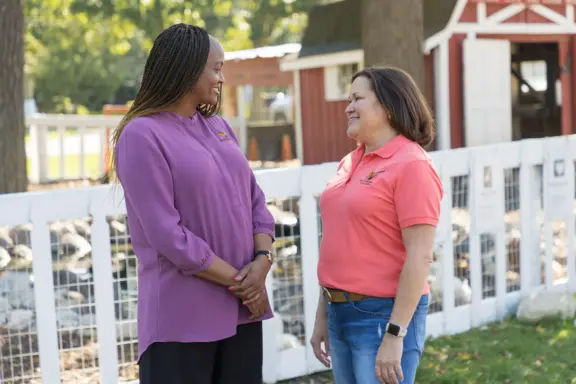
Ray Graham Association is Moving from “Budgeting” to “Financing”
From the Desk of Kim Zoeller
In 1950, a dozen concerned parents wanted more for their children than “lifetime care” in an institution. They rolled up their sleeves, passed the hat, and, with $240.83 in the bank, created what would become Ray Graham Association (RGA).
75 years of experience and expertise has proven what our founders knew all along: “providing care” must be the floor, not the ceiling. People with intellectual and developmental disabilities (I/DD) can live, work, and become active members of their community. That’s why our mission is ambitious: to empower people.
In the nonprofit sector, organizations often report on how they “did more with less.” You will not read that in this annual report. It suggests that financial efficiency is more important than human efficacy—and at RGA, we know every investment we make into someone’s wellbeing is worth making.
There is a meaningful, but bridgeable gap between what the state pays for and what empowerment actually costs. That gap is where innovation happens, where together we build something better than the status quo. Your investment ensures that ‘empowerment’ isn’t just a buzzword in our mission statement, but a funded, sustainable reality for every person with disabilities in our community.
Thank you for walking along with us as we fulfill our mission.
With determination and gratitude,
Kim Zoeller
President & CEO
The (True) Cost of
Empowerment
We have identified three strategic areas where government funding falls short, and where your private investment creates the highest return on human potential.
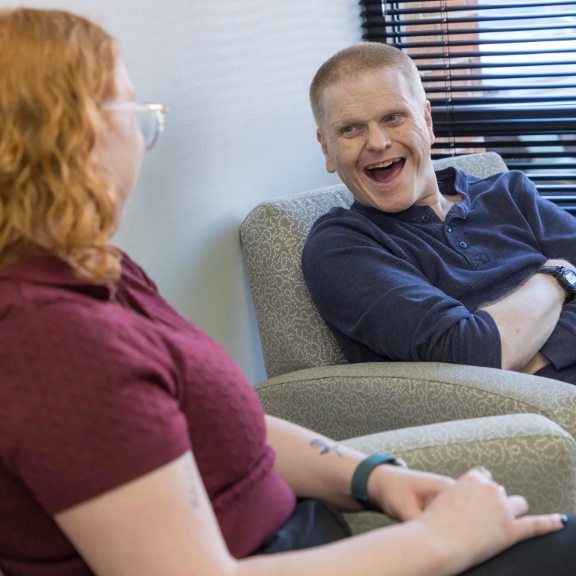
Emerge Behavioral Health Clinic
- The Challenge: People with I/DD face a mental health desert, often leading to overmedication and preventable hospitalization.
- The Solution: The Emerge Behavioral Health Clinic currently stabilizes 116 clients, preventing six hospitalizations this year alone.
- Your Impact: Your capital expands access to the wider community—already serving 25 new individuals—funding a specialized, “whole person” therapy that standard clinics cannot replicate.
Human Capital
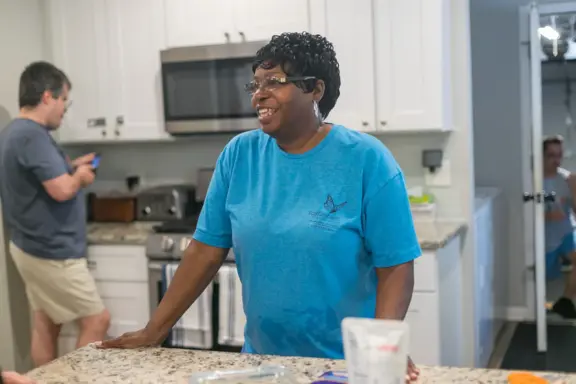
- The Challenge: A national workforce crisis threatens care continuity. High turnover destabilizes lives.
- The Solution: A commitment to living wages that exceed state reimbursement rates.
- Your Impact: By bridging the gap between state rates and competitive wages, you secured an 82% retention rate this fiscal year for Direct Support Professionals. This stability directly translates to safer homes and deeper, trusting relationships.
Community Infrastructure
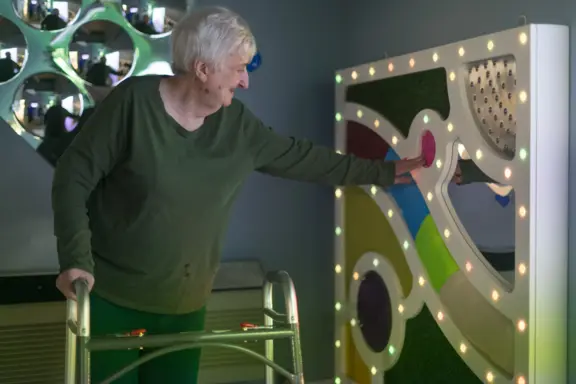
- The Challenge: True independence requires mobility, modern tech, and accessible housing.
- The Solution: 33 community homes and a logistics fleet that drove 402,410 miles in FY25—circling the globe 16 times to get people to their doctor and their job.
- Your Impact: State grants often exclude maintenance and upgrades. Your investment keeps vehicles safe and homes smart, powering the 34,800+ trips essential for employment and healthcare last year.
Your Investment
(FY25 Annual Report)
While government funding provide a baseline of care, it is your flexible partnership that bridges the gap between basic care and true empowerment and independence.
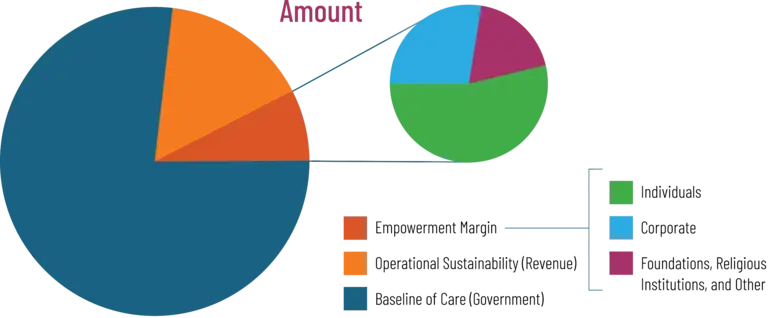
Empowerment Margin
(Contributions):
7% ($2.2M)
Source: Individuals ($1.2M), Corporations ($608k), Foundations ($394k)
Role: This capital is flexible. It funds innovation, gap-filling, and holistic support.
Operational
Sustainability (Revenue):
6% ($4.6M)
Source: Earned Revenue, Management Fees, Private Pay, Investment Income.
Baseline of Care
(Government):
77% ($22.8M)
Source: DHS/Government
Funding
Role: Restricted funds for basic service units.
Your Opportunity
(FY26 Financing Plan)
By combining stable government funding with aggressive capital grants and your mission-aligned investment, we are fully financing a strategic vision that ensures we don’t just maintain services but expand them.
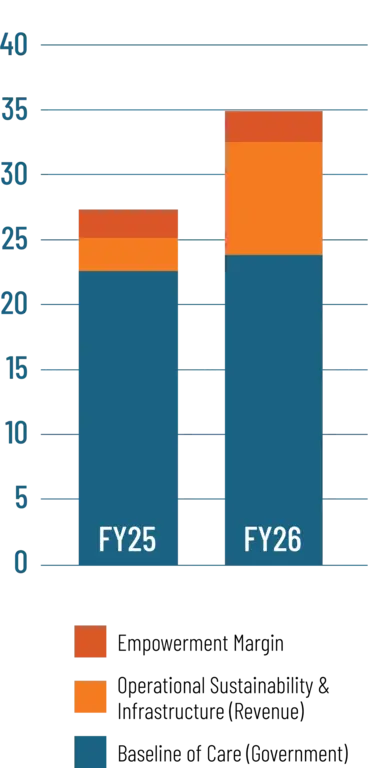
Empowerment Margin (Contributions):
7% ($2.4M)
Source: Individuals, Corporations, Foundations
Role: This capital is flexible. It closes the wage gap for our staff and funds the expansion of our behavioral health clinic.
Operational Sustainability & Infrastructure (Revenue):
25% ($8.7M)
Source: Earned Revenue, Management Fees, & Capital Grants
Role: Diverse revenue streams, including one-time capital investments, to modernize our 33 community homes.
Baseline of Care (Government):
68% ($23.9M)
Source: DHS/Government Funding
Role: Restricted funds for basic service units.
The Empowerment Gap:
-
2024-25 Total Income: $29,604,249
-
2025-26 Budgeted Need: $33,969,094
While government funding provide a baseline of care, it is your flexible partnership that bridges the gap between basic care and true empowerment and independence.
Return on Investment (Outcomes):
-
Employment: 86% retention rate for individuals placed in jobs.
-
Community: 259 volunteers with disabilities and special skills gave back to their local communities, contributing 5,262 hours—equivalent to 219 days of continuous service.
-
Trust: Consistently accredited by the Council on Quality and Leadership (CQL) since 1997, currently holding Accreditation with Distinction.
While government funding provide a baseline of care, it is your flexible partnership that bridges the gap between basic care and true empowerment and independence.